

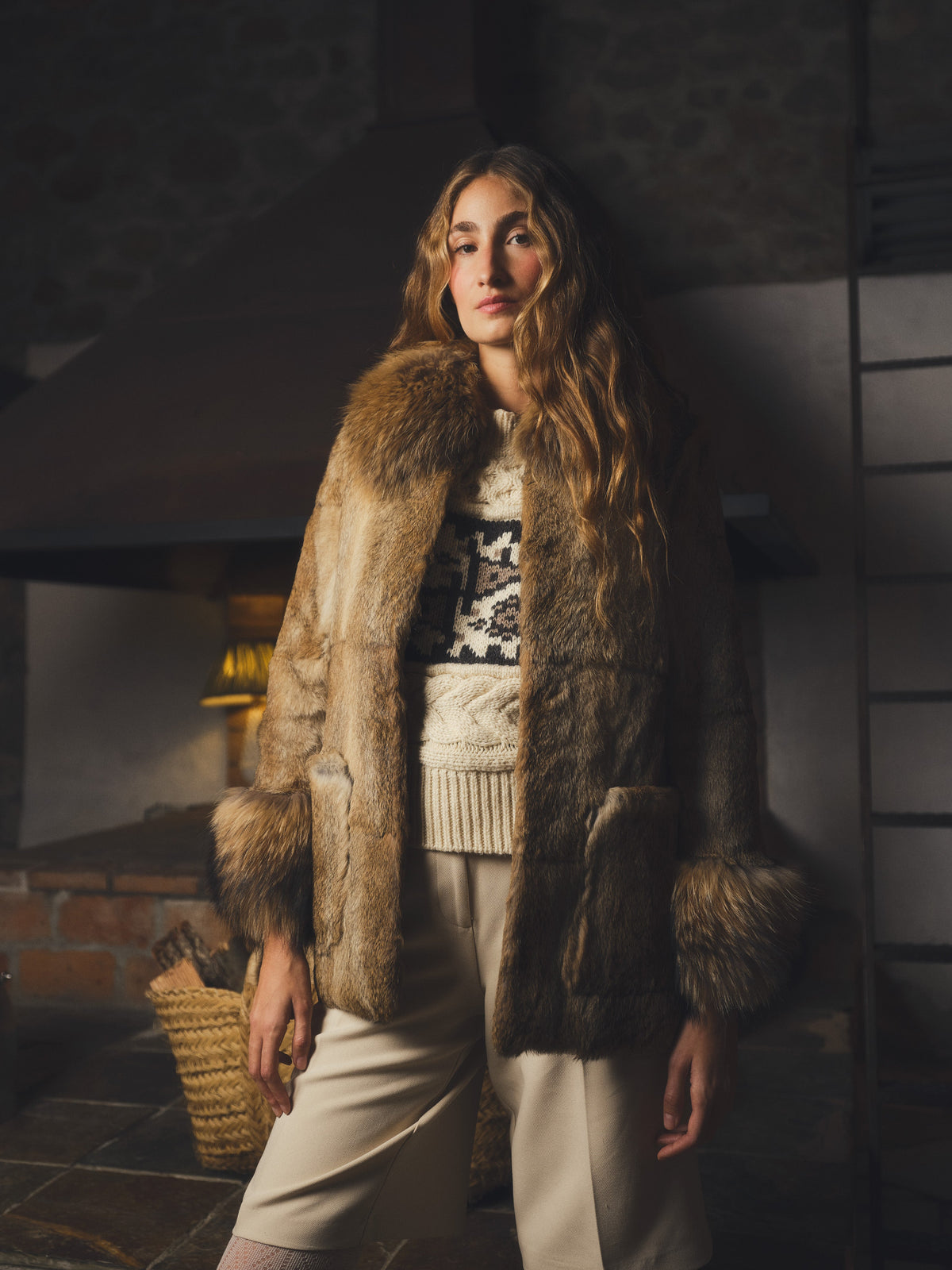
What fur coat suits you best according to your height and figure
Choosing a fur coat without considering your height and silhouette is the main reason many women end up with spectacular garments on their coat rack that they barely wear. Which fur coat suits your body is a technical decision, not an aesthetic one, and depends on measurable variables: height, shoulder width, waist-to-hip ratio, and torso length. This guide helps you identify your silhouette and choose the style that suits you best.
How to know which fur coat suits your body
Before focusing on the style, it is useful to understand the logic: a fur coat adds or subtracts visual volume in specific areas. The goal is always the same: to balance the silhouette into a harmonious proportion. That is why the piece that flatters one person may overwhelm another. Identifying your body type is the starting point.
Before you start: the four basic silhouettes
The most widely used silhouette model in fashion groups female bodies into four types. Each suits different styles in furwear:
- Inverted triangle (Y). Shoulders wider than the hips. Upper size larger than lower.
- Triangle (A). Hips wider than the shoulders. Lower size larger than upper.
- Rectangle (H). Shoulders, waist, and hips of similar width. Fairly straight line.
- Curvy (X) or hourglass. Defined waist with balanced shoulders and hips.
Knowing your silhouette is the first step. The easiest way is to stand in front of a mirror in your underwear and look at yourself from the front: clothes do not lie.
Inverted triangle silhouette: balance the shoulders
If you have wide shoulders and narrow hips, you should prevent the fur coat from accumulating volume on the shoulders. What you need to do: add presence to the lower area and limit volume on top.
What suits you
- Long coats below the knee (they add volume at the bottom)
- Let-out technique or vertical pull (slims and reduces apparent volume)
- Short-haired mink is preferable to long-haired fox
- Small collar or lapel, without abundant fur around the face
What to avoid
- Very dense fur jackets on the shoulders
- Large fur hoods (raccoon, fox)
- Very abundant fur on the chest and neckline (it adds volume where there is already too much)
Triangle silhouette: balance the hips
If your hips are wider than your shoulders, what you need is to add presence to the upper area. This is probably the silhouette that furwear adapts to best: many fur garments naturally add volume on top.
What suits you
- Short jackets to the hip or thigh
- Long-haired furs (fox, raccoon) that add volume to the shoulders
- Wide collars and fur hoods
- Coats with eye-catching details on the upper part (large buttons, defined shoulders)
What to avoid
- Long straight coats that continue the line of the hips
- Belts that emphasize the hips
- Furs with horizontal pull (visually widens)
The CHAMONIX (jacket with a raccoon collar) is a very flattering style for this silhouette.
Rectangular silhouette: create curves
If your body has a fairly straight line from shoulders to hips, fur coats can help you create the illusion of curves. Here you have maximum flexibility in style.
What suits you
- Belts that define the waist (buy coats with a belt or add one)
- Fitted jackets at the thigh
- Wide collars to "open up" the shoulders
- Furs with herringbone or diagonal pull (they create visual dynamism)
What to avoid
- Straight coats without a defined waist (they accentuate the straightness)
- Exaggeratedly oversized styles
The MEGÈVE (crystal fox with herringbone pull) illustrates the type of piece with visual dynamism that flatters this silhouette, as the fur pattern breaks the straight line and adds movement.
Curvy silhouette (X): respect the proportion
If you have a defined waist and balanced shoulders and hips, your priority is not to break that natural proportion. The fur coat should follow the waist, never completely cover it.
What suits you
- Fitted coats or coats with a belt that respect the waist
- Knee-length or above, which maintain the proportion
- Medium-density furs, neither excessively voluminous nor flat
What to avoid
- Straight and oversized styles that hide the waist
- Excessive fur volume that widens the outline and erases the curves
The height factor: how to adjust the length
In addition to the silhouette, height determines the ideal length. As a general reference: if you are short, short styles or thigh-length styles visually lengthen the leg; very long coats can "cut" the figure. If you are tall, you have the freedom to wear lengths below the knee, which take advantage of your verticality without overwhelming you. Always combine the silhouette criterion with height: that intersection is what truly defines which fur coat suits you.
Conclusion: choose by proportion, not by trend
A well-chosen fur coat is not the most expensive or the most eye-catching, but the one that balances your silhouette and respects your height. Identify your body type (Y, A, H, or X), decide which area you want to enhance or soften, and choose the style, length, collar, and type of fur accordingly. With that method, the garment stops staying on the coat rack and becomes the piece you use most every winter.


